Inside an Agent’s Inbox: My Top Insights from 2025 Queries
Analyzing word counts, sports romances, and upmarket fiction
I spent a few weeks in December catching up on my query inbox. I had promised myself that I’d start the new year with a completely cleared-out inbox. Unfortunately, that didn’t happen. I knew it was a stretch goal (because I also wanted to take some time to recharge this holiday season), but I did my best! All in all, I managed to get through over 400 queries in the two weeks I was out of the office.
If you don’t already know, I moved to The Caldwell Agency in August of 2025, and I switched from email queries to Query Manager. And boy does Query Manager help in terms of data tracking! This post is (loosely) brought to you by that data.
The insights in this post are going to refer to my query inbox since my move to TCA. That’s the data pool we’re talking about here, simply because that’s what I have access to!
A few things to note:
These insights are based solely on my inbox. Which means that this sample pool consists of writers who already thought their work would be a good fit for me.
Take these insights with a grain of salt. While I have hard data on genre breakdowns, the rest is based on what I interpreted and noticed. I don’t take notes on every single query, so this is not 100% scientific.
The breakdown:
I opened to queries at the end of August 2025, and closed early December because I was receiving significantly more queries than I could keep up with
Over those five months, I received a total of 959 queries.
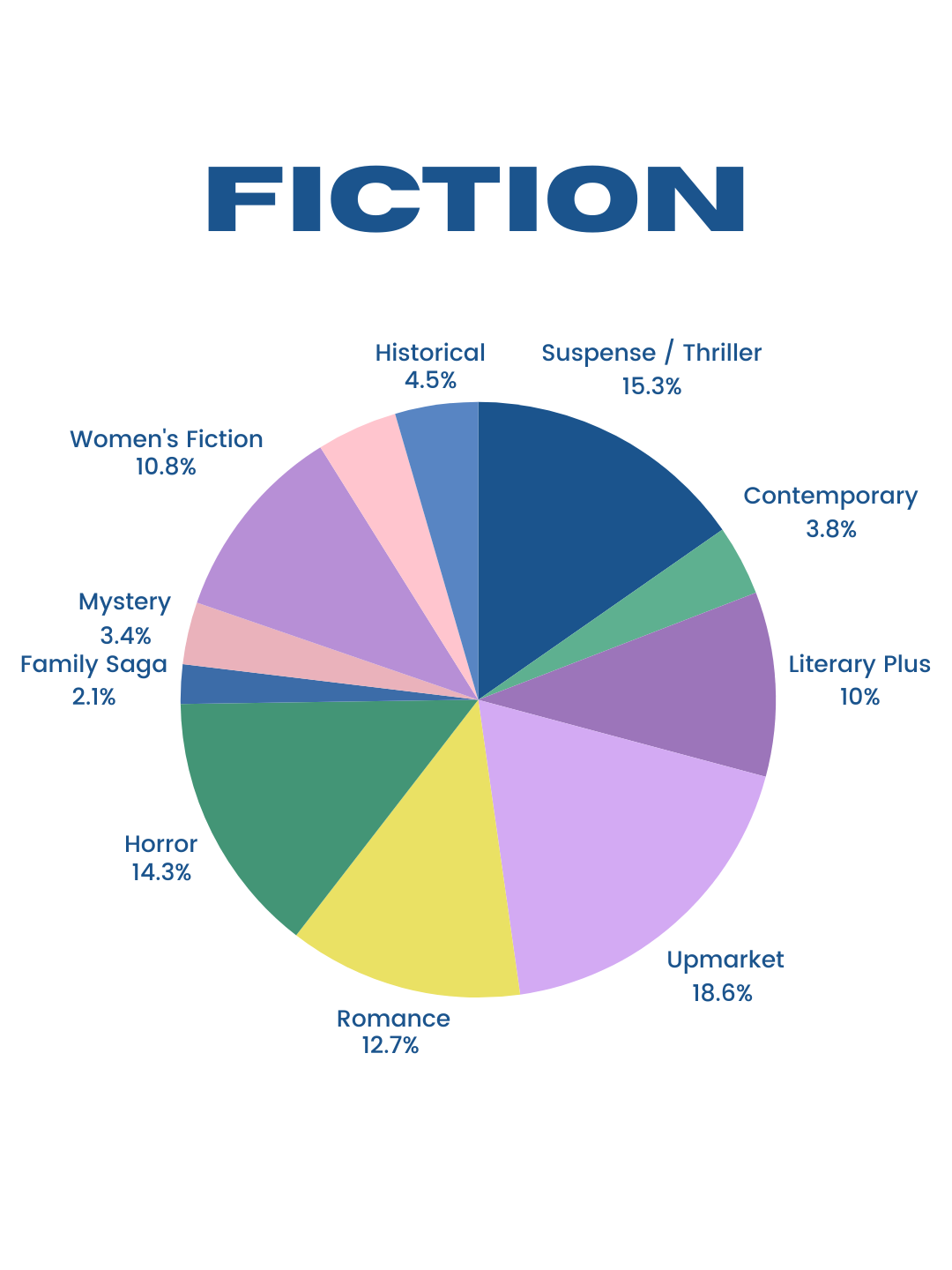
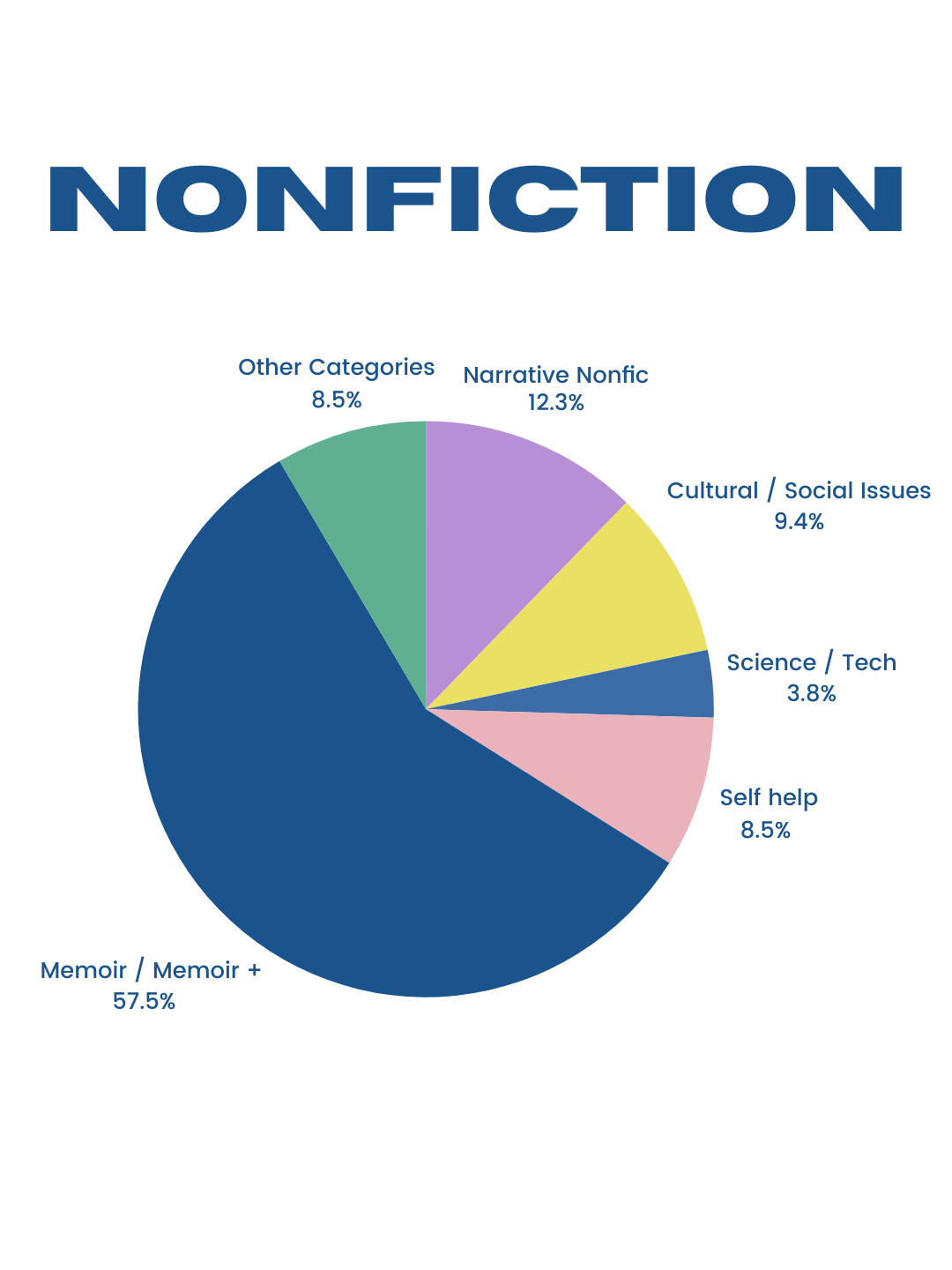
Here are a couple of charts breaking down the genres I received—because I love looking at a pretty chart!
My top insights:
Most comped titles in my inbox
Before diving into my analysis, I thought it would be interesting to share the titles that are frequently comped in my inbox. I’ve broken them down by fiction and nonfiction.
Fiction:
YELLOWFACE by R.F. Kuang
I HAVE SOME QUESTIONS FOR YOU Rebecca Makkai
BLUE SISTERS by Coco Mellors
MEXICAN GOTHIC by Silvia Moreno-Garcia
BUNNY by Mona Awad
THE GUEST LIST by Lucy Foley
OUR WIVES UNDER THE SEA by Julia Armfield
BEACH READ by Emily Henry (or Emily Henry in general)
Nonfiction:
THE GLASS CASTLE by Jeannette Walls
EDUCATED by Tara Westwood
An important note: The last two fiction titles, along with a couple Emily Henry books, are on my personal wishlist, so that could also be influencing in their presence on this list.
I’d be interested to see a survey of the most comped titles in 2025 across several agents’ inbox. For research, you know. So if anyone wants to do that study, I’d be very keen to read it.
An increase in shorter novels
I’ve noticed an uptick in contemporary and genre fiction query letters with wordcounts between 60,000 to 70,000. Of course, I got pitched novels in that range before, but there was a distinct surge over the last few months.
In August, The Bookseller reported that publishers are noticing a growing appetite for shorter books like. This mirrors some of the industry conversations I’ve been having. As agents and editors, we’re constantly monitoring the attention spans of readers, and what we’re competing with in terms of readers’ attention. This feels like an extension of that.
It’s too soon to tell whether shorter novels will be significantly more popular in the near future than they were in the past few years. It might continue to be just the “one-off” book that truly dazzles. But I find this to be interesting observation!
What does this mean for writers? I don’t have a definitive answer. There’s certainly room for novels that are a few thousand words shorter than what is considered “average” in a genre. I wouldn’t hesitate to pick up a 65,000-word novel that’s well-paced and well-developed. But is that the general consensus? I’m not sure. Time will tell.
And what about novellas and short stories?
Truthfully, I’d love for novellas to gain popularity in the mainstream publishing market and become another commercially viable category. I don’t necessarily see short story collections breaking out in the same way, but I think it could be possible for novellas (especially as we see an increase in short form audio originals).
Inheritance as the inciting incident
Across genres, I’ve seen a lot of queries with a plot that is propelled by an unexpected inheritance, or the threat of a loss of inheritance. I’ve seen it in women’s fiction, romance, and, of course, horror and mysteries. It’s usually a surprise inheritance of mansion, land, or business that causes the main character to move or switch careers.
It’s not a trope I get tired of, but it does mean that when I do see it, I want an added “sparkle” elsewhere in the pitch, ie: I want to see something else that’s new and fresh in the concept to make it stand out.
Strange voices echoing in horror
I love horror with strange, eerie voices echoing in the night! I really do. But it gets mentioned so frequently in horror pitches that I’ve become desensitized to it as the creepy factor (in a pitch, not a book!).
I’m very aware that this is a subjective take. I also know that if I stopped seeing these pitches entirely, I would miss them. But if you’re a horror writer, I’m here to tell you that this is unfortunately not going to set your query apart. If your haunted house relies on the auditory creeps, you’re going to need something more.
Second-chance romance where a decade passes before they reunite
Second-chance romances are my favorite type of romances— and the writers in my query inbox know that! But I’m starting to wonder: why is it always ten years of no contact? Why not 6 months? 3 years? And why is it absolute zero contact?
Where are the stories where the second chance doesn’t require you to be an entirely different person a decade later? I know you’re out there, and I want more of those!
That said, I have a decade-apart romance on my list that I’m absolutely obsessed with. But as with the echoes in the hallways, I’m looking for a fresh twist if we’re using a familiar trope.
Is tennis the next hockey?
Move over, hockey. Tennis is in town. I’m seeing fewer hockey and F1 romances and way more tennis romances— and I’m hooked. I loved Challengers, and I’d love a book that gives off that vibe.
There’s always talk about whether sports romance is going to taper off, but I really don’t think so. There are too many sports we haven’t spotlighted yet. One of my agent friends is looking for a curling romance, which is mind boggling to me as an avid curling hater, but there’s a sport for everyone!
Memoir plus or another nonfiction category?
The memoir plus category as a whole is confusing. It’s a category with very loose boundaries. We’ve all seen industry professionals talking about how memoirs nowadays need a “plus” element to sell. Which is partially true, and I have personally said it myself! But in saying that so much I fear that writers now assume that we only want these types of books.
As you can see in the chart above, almost half of the nonfiction queries I’ve received are pitched as memoir plus. But most of these books do not actually fit the memoir plus category. This is usually because of one of two reasons:
The personal narrative needs to be more developed in order for the book to fit the memoir expectations.
The "plus" element is more compelling and overshadows the memoir, which makes the book a better fit for a different nonfiction category (eg: history, health, nature, or even self-help)
For a memoir plus to work, both elements, the memoir and the plus, need to be necessary. They both need to be equally important and add value to the book.
If you’re writing a memoir plus, I urge you to consider whether your book is a good fit for the category.
Here are some questions you can ask yourself:
Is the personal narrative well-developed?
Does it weave in effortlessly or does it read as a jarring departure from your research/ journalism/ etc.?
What is the personal narrative adding to the book? Most writers relate to the world through their personal story, but that doesn’t necessarily mean that the personal narrative is a sharp enough or necessary enough for the reader to relate to the topic.
Could the book survive (or thrive) if it’s positioned in a different nonfiction category?
Pitching “Upmarket literary”
I’ve noticed many writers positioning their book as “upmarket literary.” Here’s the issue: that isn’t really a thing.
Think of it like a scale. On one end is commercial fiction, which focuses on plot and tends to be fast-paced. These are the books we tend to think of as “accessible.”
On the other end of the scale is literary fiction, which tends to be character-focused and introspective, with heavier focus on the craft of writing.
Upmarket fiction blends the two. These books are accessible and focus on both plot and character. They tend to be the book club books because they have a wide appeal. If it’s on Reese’s list, it’s most likely upmarket!
Your book is either upmarket or literary. It can’t be both. While some upmarket titles can lean a little more literary than commercial, using the term “upmarket literary” defeats the purpose of the upmarket category since it inherently blends the two. This can lead agents to wonder whether you’re accurately positioning your book or whether you don’t know your market. We know that upmarket blends both literary and commercial fiction to some extent. We expect your book to have a bit of both if it’s positioned as upmarket fiction. Pitching an “upmarket literary” makes me wonder if it’s really just a literary novel in disguise.
Final thoughts:
I read a lot of queries this season.
These observations were born out of living and breathing my query inbox for days straight. Again, this isn't scientific data! Agents are tastemakers; we curate our lists according to our taste. What I might not like, someone else might love. What I might see a lot of in my inbox, another agent is dying to see more of.
And remember: there is nothing wrong with telling a story that’s been told before, as long as you breathe new life into it, twist it, spin it, and write it anew.
Good luck with your querying! And if you’ve queried me, I promise I’m doing my best to get to it!