Is Your Book Club Book Actually a Book Club Book?
Not all upmarket books are book club books, and why that matters.
Last month, I shared some insights from my 2025 query inbox. One trend that stood out to me was the influx of manuscripts pitched as “upmarket literary.” As I discussed in my last post, your book generally can’t be both. And while the distinction between the two is often murky, I mentioned how important it is to know the difference in order to position your book correctly.
Today, I want to go a step further. In that previous post, I wrote that “upmarket books tend to be book club books." While that’s a common phrase used in the industry that I’m guilty of using, I’m beginning to think that it’s inadvertently caused a bit of a mess in my inbox. Many writers now assume that every upmarket book is a book club book.
That simply isn't true. So today, I’m going to try to untangle the two as best as I can.
What is upmarket fiction?
Let’s start with a basic refresher. In my last post, I talked about the “sliding scale” of categories. I think of it this way:
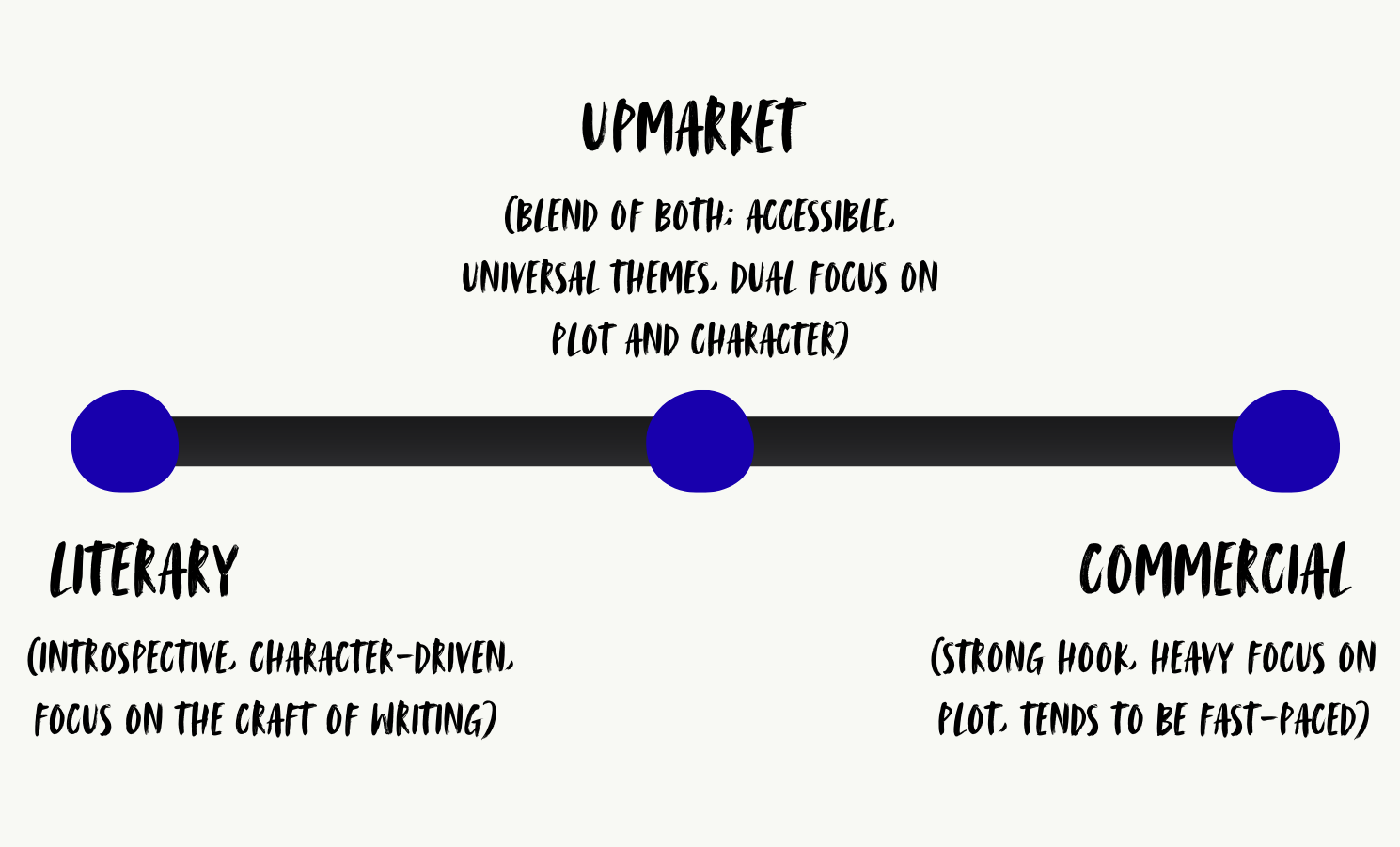
Visualizing where these categories lie on a scale helps me see them as malleable. Your book can fit anywhere on this scale, but it will typically lean toward one of these three posts more than any other.
As you can see, upmarket fiction is situated between commercial and literary fiction. And as we’ve already established, upmarket books tend to be book club books. Books like The Wedding People and Lessons in Chemistry fit this bill.
If you’re interested in a deeper breakdown, check out Carly Watters’s piece on upmarket fiction, which I also linked in my last blog post. Reedsy also has a great breakdown on upmarket fiction here.
But here’s the thing: not all upmarket books are book club books.
What is a book club book?
In order to parse through what is and isn’t a book club book, let’s start by trying to draw out the “shape” of a book club book. What makes a book a book club book?
In an industry sense, a "book club book" is less about the prose and more about the discourse potential. Books that are labelled and marketed as book club books are driven by a central or polarizing dilemma or hook that practically begs for a group discussion. They usually feature "sticky" themes: moral gray areas, complicated family secrets, or social commentaries that leave room for conversation— and sometimes disagreement.
Books like Little Fires Everywhere (Celeste Ng), The Wedding People (Alison Espach), Yellowface (R.F. Kuang), The House of Eve (Sadeqa Johnson), and Broken Country (Clare Leslie Hall) are book club books. They have universal themes, character-driven emotional cores, and "what would you do?" scenarios that can keep a conversation moving for hours.
Books that fit into the book club book category, or what the industry views as “book club books,” are typically books that have that ability to spark discussion.
Upmarket vs Book Club
It helps to think of “upmarket” as a category of writing style, and “book club” is a marketing label (or genre). The literary, upmarket, and commercial scale refers to the type of writing you can expect from the book. A Carolyn Huynh book is likely upmarket in writing (The Fortunes of Jaded Women, The Family Recipe). A Sally Rooney book is literary (Beautiful World, Where Are You; Intermezzo).
This also means that just because your book is upmarket doesn’t automatically make it a “book club book.” You can write a perfectly paced upmarket novel, but if it doesn’t have a hook that lends itself to discourse, it’s just an upmarket novel. It won’t get pitched or marketed as a "book club book.”
It is true that book club books tend to have upmarket writing. But thinking of it in terms of a marketing category helps explain why some literary books can be book club books, too.
But any book can be in a book club??
Another important distinction: Not every book can be a “book club book”, but any book can be in a book club. Say that five times! That sounds convoluted, I know! But what I mean to say is that any book, regardless of category or genre, can be read by a group of people who get together and read books.
Your book club can pick up a book by Frieda McFadden (commercial), George Saunders (literary), or Carolyn Huynh (upmarket)— and you’ll all have a great conversation because you read a book together as a community! Yay! How fun is that?!
Upmarket does not have to be the requirement for a book to be in a book club. What we refer to as “book club books” in the industry does not prevent consumers from taking a product and doing with it what they want to do. Still, there is a Venn diagram between the books that we as an industry label as “book club books” and the books that hit nationwide book clubs like Reese’s Book Club and Read With Jenna. And that is for a reason: These book clubs tend to be popular and have a wide-reaching audience, so they pick books that have the likelihood of sparking conversation and (supposedly) appealing to many audiences.
But this is not to diminish the wonderful (and often more inclusive) book clubs out there, like Dua Lipa’s Service95 (my personal favorite) that pick up literary books as well, or national book clubs like Book of the Month, which features a wider selection of both upmarket and commercial books. They, too, deserve their own stamps.
Why the distinction matters
So why does the distinction matter? Really, it doesn’t. Not for readers, at least. But for the industry, it does. As an industry, we need categories in order to determine target audiences and market positioning. Even if these categories are annoying and frustrating to you as a querying writer, they are necessary in the business sense. Industries need standardized communication tools in order to function. Categories are one way to do that.
So how you pitch your book to agents or editors does matter. When you label your book as a "book club book" in a query letter, you are telling the agent what to expect in terms of content (making a promise about the social effect of your story) and market (that your book has a hook sharp enough to not only appeal to ten different people with ten different tastes, but to get them talking). Pitching your book in the right category helps me, as the agent, determine which publishers I can sell to, and later, they help the publishers and booksellers determine where your book can be placed in the publishing eco-system.
Does that mean that miscategorizing your book is the be-all and end-all? Should you stress about that query you sent last week? No. As agents, we understand that not everyone is knowledgeable about these distinctions. I’ve requested queries that are miscategorized because I was still curious and wanted to read the book. I’ve set up calls with authors where I’ve said, “I actually think we should position your book as X.”
But knowing as much as you can about the industry and the way it works, and doing your research on your market, will surely set you up for the better— not just for querying, but also as an informed business partner when you do land an agent and a book deal.